Graduation dress
The Captain and Ann BarbaraThe graduation dress that Mary Antin wore on her graduation day from the Winthrop School grammar school in Chelsea was not merely a garment but the material culmination of her family's American hopes. It was sewn by her sister Frieda, who sacrificed her own trousseau-making to create it, and it was completed with a sash with silk fringes that Frieda bought specially after the dress was already finished and pronounced beautiful. The dress transformed Mary, on Graduation Day, into what she described as being "arrayed like unto a princess," complete with frills, lace, and patent-leather shoes. It was the physical proof that the immigrant family's investment in education had borne visible fruit, and it stood in stark contrast to the poverty that surrounded the Wheeler Street tenement where the family lived.
The Making of the Dress
The dress was born out of an act of sisterly sacrifice that Mary only fully understood in retrospect. Frieda, who had come to America too late to avail herself of the gifts of an American girlhood and was engaged to be married under the old dispensation, suddenly turned spendthrift in the weeks before Mary's graduation. She appropriated fabulous sums to spend just as she pleased, attended bargain sales, and brought home finery that had never before graced the family's flat. Home from work in the evening, after a hurried supper, she shut herself up in the parlor and cut, snipped, measured, basted, and stitched as if there were nothing else in the world to do. It was early summer, and the air had a wooing touch even on Wheeler Street; Moses Rifkin, her fiancé, came to visit, but Frieda only smiled and shook her head, her mouth full of pins, making it physically impossible for him to argue. She remained all evening in a white disorder of tucked breadths, curled ruffles, dismembered sleeves, and swirls of fresh lace, her needle glancing in the lamplight while poor Moses picked up her spools. The trousseau she was working on was not her own—it was Mary's graduation dress. And when it was finished and pronounced most beautiful, Frieda went to the shops once more and bought the sash with the silk fringes.
The Ceremony and the Crowd
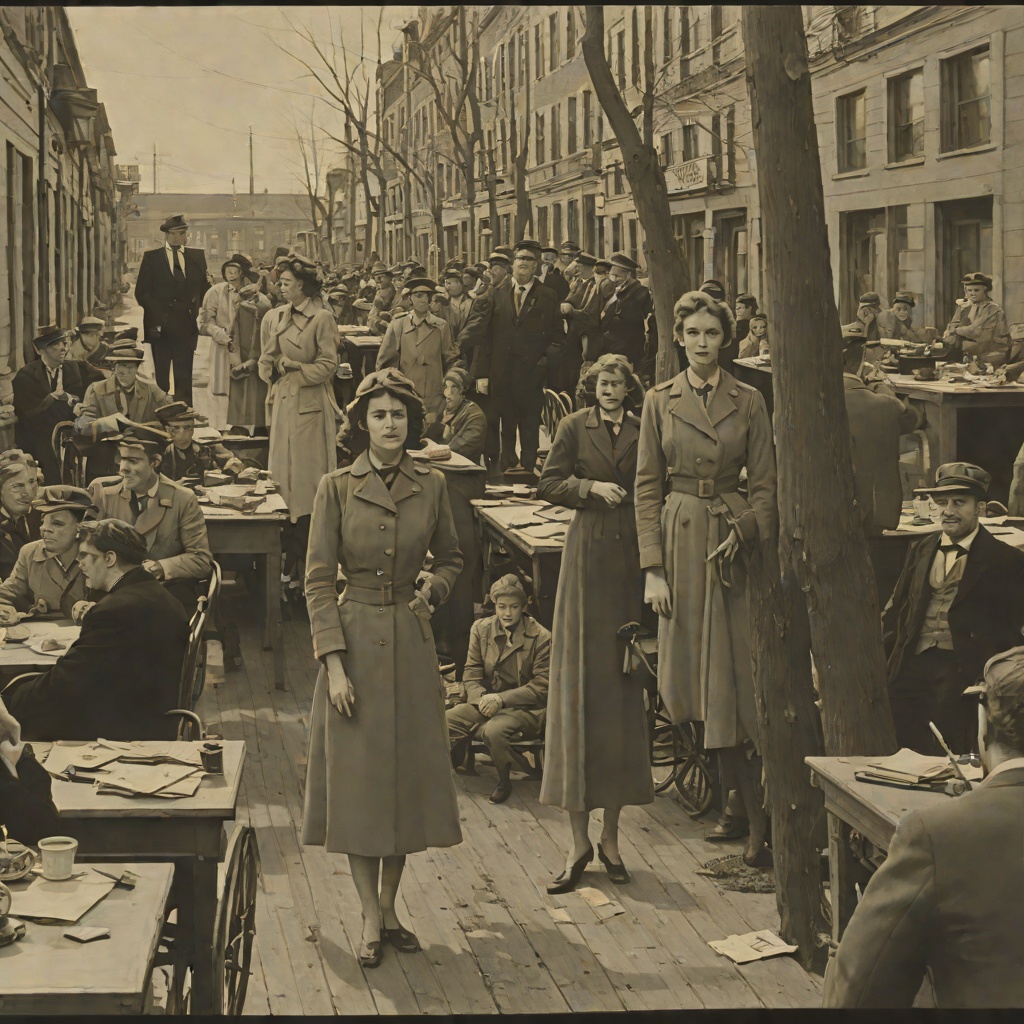
On Graduation Day itself, the dress became the centerpiece of a public triumph. The assembly hall was crowded to bursting, but Mary's friends had no trouble finding seats; they were ushered up to the platform, which was reserved for guests of honor. Her parents were there, and Frieda of course, along with Miss Dillingham and some others of her Chelsea teachers, while a dozen or so of her humbler friends and acquaintances were scattered among the crowd on the floor. Mary was known in her school district as the "smartest" girl in the class, and all eyes were turned on the prodigy. She had two pieces to speak, one of them an original composition about her cousin who had died in Russia. But when she stepped up on the stage to read, she was seized with stage fright. The floor under her feet and the air around her were oppressively present to her senses, while her own hand she could not have located. She did not know where her body began or ended, she was so conscious of her gloves, her shoes, her flowing sash. Her wonderful dress, in which she had taken so much satisfaction, gave her the most trouble—she was suddenly paralyzed by a conviction that it was too short, and it seemed to her she stood on absurdly long legs, with ten thousand people looking up at her.
The Thank-You Blunder
After the singing and reading by the class, there were the customary addresses by distinguished guests, reminding the girls that they were going to be women and promising happiness to those who aimed to be noble women. Then came the moment that turned the dress's triumph into ashes. Mary rose where she sat and began, in a voice that sounded thin as a fly's after the oratorical bass of the last speaker, "I want to thank you—" That was as far as she got. Mr. Swan, the principal, waved his hand to silence her, and only then did she realize the enormity of what she had done. Her eulogist had had the good taste not to mention names, and she had been brazenly forward, deliberately calling attention to herself when there was no need. She hated herself, hated with all her heart the girls who had prompted her to such immodest conduct, wished the ground would yawn and snap her up. She was ashamed to look up at her friends on the platform, wondering what Miss Dillingham was thinking of her. She had ruined her own triumph, disgraced herself, her friends, poor Mr. Swan, and the Winthrop School. After the exercises, when the crowd pressed in all directions in search of friends, she tried in vain to get out of the hall. She was mobbed, lionized; everybody wanted to shake hands with the prodigy of the day. The people smiled on her, flattered her, passed her on from one to another. She smirked back but did not know what she said, wild to be clear of the building, thinking everybody mocked her. All her roses had turned to ashes, all through her own brazen conduct. She would have given her diploma to have Miss Dillingham know how the thing had happened, but she could not bring herself to speak first. The sting of shame smarted just the same; she could not be consoled. She had made a fool of herself: Mr. Swan had publicly put her down. And then she understood—it was wounded vanity that writhed and squirmed. It was not because she had been bold, but because she had been pronounced bold, that she suffered so monstrously.
The Dress as Symbol of Transformation
The graduation dress belongs to a larger pattern of clothing and self-presentation in Mary's American story. It recalls the red-and-green plaid frock she wore when she stood before her class to recite her Washington's Birthday poem—a dress that had a ghastly effect on her complexion, which she hated when she thought of it, but on that great day she did not know she had any dress on. It also connects to the first-school calico dress of her earliest American days, and to the broader Wheeler Street culture in which graduation was one of five great events in a girl's life—christening, confirmation, graduation, marriage, and burial—all requiring full dress for the heroine, no matter if the family went into debt for it. There was not a girl who came to school in rags all the year round that did not burst forth in sudden glory on Graduation Day, with fine muslin frocks, lace-trimmed petticoats, patent-leather shoes, perishable hats, gloves, parasols, and fans. A mother who had scrubbed floors for years to keep her girl in school was not going to have her shamed in the end for want of a pretty dress, so she cut off the children's supply of butter and worked nights and borrowed and fell into arrears with the rent. The dress thus carried the weight of the entire immigrant community's sacrificial investment in its children's American future, the visible proof that the family's journey from Polotzk to Chelsea had been worth it. And yet the same dress that crowned Mary as a princess also exposed her vanity, the flaw that turned her moment of glory into an agony of shame—a reminder that even the most triumphant Americanization could not erase the self-consciousness of the immigrant girl who wore it.